Skip to content

The Insight Collective

AI fails where technology, work, and organization collide.

The Insight Collective helps leaders understand why AI initiatives stall, fracture work, or create consequences no one planned for. We examine the technology, the organization, and the people affected as one connected system.

Why the Collective exists

AI rarely fails for one reason

Organizations often treat AI failure as a model problem, an adoption problem, or a governance problem. In practice, these conditions reinforce one another. A technically capable system can still fail because the work was misunderstood, the incentives were misaligned, the evidence was weak, or the people closest to the consequences had no practical way to challenge it.

The Insight Collective examines those dependencies together.

Three dimensions

Read our principles →
  • Organization

    AI inherits the incentives, structural divisions, information barriers, ownership conflicts, and operating weaknesses of the organization deploying it. Faster technology can accelerate those weaknesses rather than resolve them.

  • Workforce

    Adoption is not a communications problem or a prompt-training problem. People interpret AI through their experience of the work, their trust in leadership, the consequences of errors, and their ability to challenge decisions.

  • Technology

    Models are only one part of the implementation. Data, integration, workflow design, controls, exceptions, observability, and operating support determine whether an AI capability can produce dependable results.

Selected principles

All ten principles →
  1. Start with the outcome and the decision

    Technology follows the problem being solved.

  2. Treat AI integration as a connected system

    Technology, work, organization, and people affect one another.

  3. Examine work as it actually happens

    Formal process maps rarely capture exceptions, workarounds, incentives, or hidden dependencies.

  4. Measure before scaling

    Adoption, speed, and activity are weak substitutes for business outcomes, trust, quality, and risk.

Latest conversation

Explore the podcast →

The podcast is where the founders test ideas, challenge easy explanations, and connect organizational, workforce, and technical consequences.

No. 0020:29:09

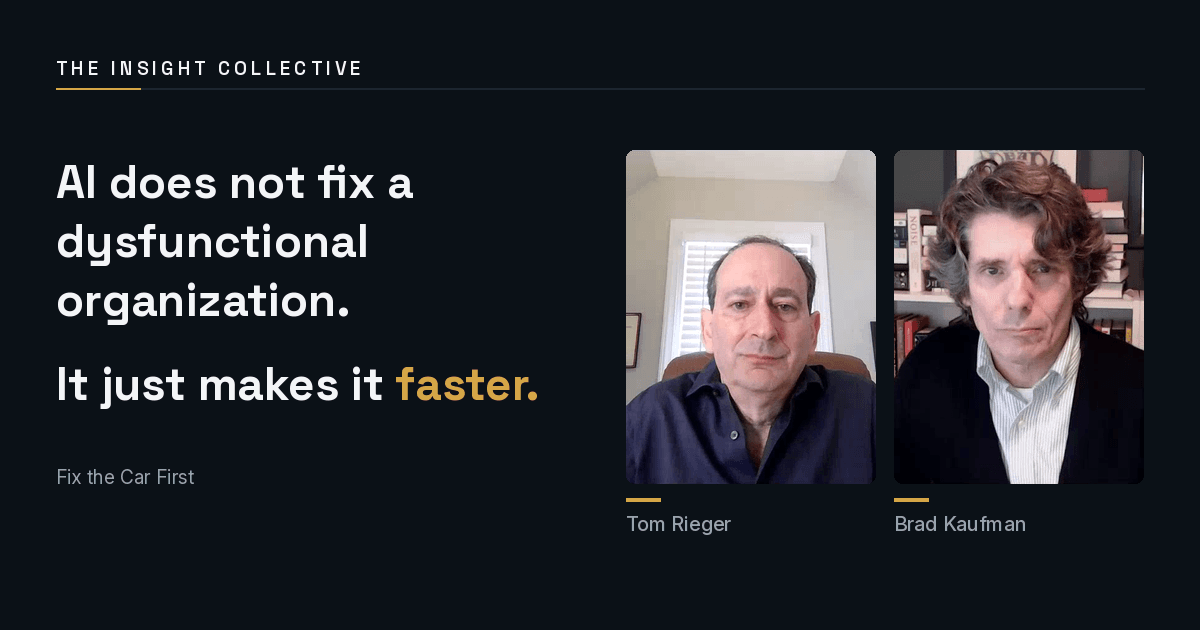
Fix the Car First

Empire Building in the Age of AI

  • Tom RiegerPresident, NBI Consulting
  • Brad KaufmanCTO and Founder, Thoughtive

Tom Rieger and Brad Kaufman on what AI does to an organization that already has silos: it does not fix the dysfunction, it makes it faster. Decision rights, source-of-truth data, and the unwritten rules nobody remembers making.

Episode page →

Tom Rieger

President, NBI Consulting

Tom Rieger is the president of NBI Consulting and the author of Breaking the Fear Barrier. A former senior leader at Gallup, where he pioneered research on organizational barriers and change resistance, he is an expert in behavioral economics, competitive strategy, and organizational performance, with more than 25 years advising Fortune 500 companies, game studios, and government agencies.

Jason Greer

Founder and President, Greer Consulting, Inc.

Jason Greer is the founder and president of Greer Consulting, Inc., a labor management and employee relations consulting firm based in St. Louis. He holds an MSW from Washington University in St. Louis and a master's in labor and industrial relations from the University of Illinois, and is a co-author of People Matter Most and Bias, Racism & the Brain. He works directly with employees on workplace satisfaction and labor relations.

Brad Kaufman

CTO and Founder, Thoughtive

Brad Kaufman is the CTO and founder of Thoughtive, an AI consulting and implementation firm. He advises executive teams on enterprise AI strategy, enterprise architecture, AI governance and complex technology transformation, and has built and corrected the kinds of large distributed systems he advises on.

Where is your AI initiative breaking down?

The Collective works with leaders responsible for AI value, operational performance, workforce impact, or program risk. We are most useful when an initiative looks technically plausible but remains difficult to adopt, scale, govern, or trust.

Discuss an AI initiative